


Time as a frozen ocean
Let’s revisit Remedy’s Quantum Break ahead of Control Resonant.

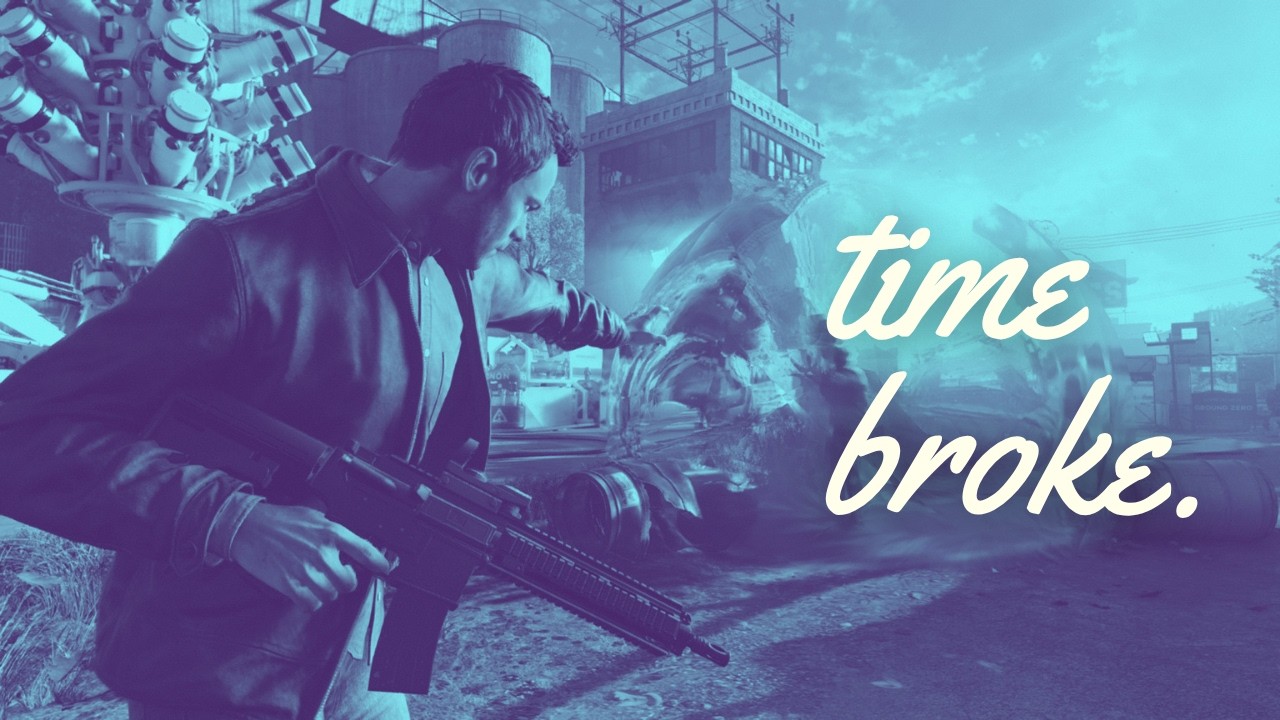
I’ve never quite believed in free will. This can make you decidedly unpopular in a room full of philosophy majors, fans of the Canadian rock trio Rush, or anyone with a vested interest in the idea that the choices we make are ours and ours alone—divorced from unseen decades of socioeconomic context, factors of the nature-versus-nurture variety, the sheer complexity of the human experience, or the potential for any Butterfly Effect mumbo-jumbo.
When dealing with characters in the realm of fiction, however, we generally take for granted that heroes, villains, and the morally gray have at least some power to live freely: they choose the course of action that aligns with their beliefs and act on it. In the interactive medium of games, one interesting wrinkle in this whole topic comes from the fact that a player is in control of the main character, at least for the majority of the time. But does the player truly possess free will here, if a game designer carefully and intentionally devised the conditions that led them to play a given scenario the way they did?
When a video game presents a choice—say, by putting a gun in the protagonist’s hand and having a companion character tell them not to shoot the enemy mercenaries patrolling nearby—how much of the narrative outcome, or the game’s response, is determined by the player? To what extent did the game designer know what players would do, and to what extent was it a fifty-fifty coinflip? Now, what if the companion character was the protagonist’s brother?
I suppose you’d have to replay the game in question and choose differently to find out. Maybe you could reload your save file, as if stepping into a time machine.
My first Remedy game was the 2001 shooter Max Payne, a neo-noir mystery about a depressed cop who heals gunshot wounds with painkillers and, most notably, can slow the flow of time. Remedy of course cribbed this “bullet-time” effect from Hong Kong cinema and directors like John Woo and the Wachowskis. Films like Mission: Impossible II and The Matrix had made the device mainstream in Western action movies, but Max Payne was among the first to let you manipulate time this way in a video game. (I certainly remember the Stopwatches in Super Mario Bros. 2 on the NES, but that’s a whole ’nother essay.) In two of Remedy’s other most beloved games, Control and Alan Wake II, various characters employ supernatural abilities to bend and shape reality and otherwise overcome obstacles through sheer force of will. But it was in a 2016 Microsoft exclusive that Remedy returned to slowing time as a fun game-design gimmick with near-limitless possibilities.
Quantum Break conceives of time itself as one big, fragile egg. And when it breaks, it’s up to the player in the role of Jack Joyce—wanderlust, activist, everyman—to make an omelette out of the whole thing. Jack has an estranged brother named William, whom he loves but hasn’t seen in years. They see the world quite differently, and they’ve got a mutual friend from the old days, Paul Serene, who represents yet another worldview, another conception of masculinity, and another attitude toward time travel and the end of the world.
So what is time travel, really? Why do we keep coming back to it in everything from Back to the Future and The Terminator to Looper and Twin Peaks? I doubt it’s because we like overly complicated plotting or the thought of killing baby Hitler. At its heart, I think that the most rational minds still love a good ghost story, and we all have regrets, painful memories, things we’ve said we wish we could take back. Even in stories like Quantum Break and Looper, where time travel is taken seriously as part of a concrete, believable reality, we recognize its potency as a lens through which to reflect on time, memory, our ghosts. People grow and change, friendships fall apart, and one day you wake up and learn that an old friend, or a loved one you haven’t spoken to in a while, is suddenly gone forever. All those unspoken conversations haunt us. Maybe we don’t have time machines or wormholes, but we experience time travel of a sort. That surreal yet familiar sense of visiting someplace from our past and realizing—it doesn’t seem so very long ago I was here in this lecture hall, or in that house where my childhood friend once lived. Or that now-demolished building that was once a library, or a movie theater where I saw Star Wars with my father, or the abandoned, rotting mall where I met my first real partner in adulthood.
I used to enter short-story contests as a young writer, which inevitably led me to reading all sorts of advice on how to win such a contest. And one piece of advice from back then has always stuck with me, even if it is a little obvious: your story ought to feature a relationship. Consider Steven Spielberg’s first film, the made-for-TV masterpiece Duel. In the original televised version, Mann did not call his wife from a payphone and have a lengthy, character-enriching, conflict-driven chat with her; there was no backstory about the protagonist’s messy marriage at all. It was a movie about a guy and a truck, and the truck trying to kill him. But, faced with extending the length of the picture for theatrical release, that was the natural route to take. And the movie’s better for it.
Whenever I bring up Quantum Break and why it speaks to me, its central relationship between the brothers is the thing that makes the game. There’s no real story without that machinery.
“Time is breaking down. The end is coming.” This bit of dialogue, delivered by Beth Wilder in the ambitious, perhaps-ahead-of-their-time live-action segments, more or less sums up the plot of the game. The clock is ticking on reality as we know it, and you can kiss goodbye to most of the human race. The ultrawealthy are still digging their bunkers and building their life rafts, naturally; the game does a great job of showing how the One Percent have a different relationship to the end of the world than the rest of us. To them, it’s just another business opportunity. “Here’s to all of us making it into the program,” some rich nobody says as you infiltrate a gala event thrown by Monarch Solutions, the shadowy corporation prepping for the end of time.
Like Control, Quantum Break is a third-person shooter with, essentially, superpowers. But a lot of its appeal and replayability comes in the form of branching narrative: “Junction Points” where the player makes a choice that has an impact on both the in-engine game world and the live-action episodes, which you can watch like the first season of a television show alongside your first playthrough. Branching is perfect for a subgenre that constantly asks: What if you could go back, do things differently? Who might you have become instead? Whose lives could you have saved, if you had a time machine—or time-bending abilities? It’s rare that all the violence and killing in a game neatly aligns with the intended narrative as presented in the performances and cutscenes, but here we have a number of interesting design decisions outside of the basic run-and-gun loop that reinforce the story’s themes rather well.
We’re a little confused because Jack is a little confused, but the characters of Beth Wilder and William Joyce—and even the villains, occasionally—assure the player that this will all make sense, in the end. And therefore that Quantum Break’s time-travel mechanics have some kind of internal logic. Junction Points and Quantum Ripples—the proverbial consequences of your actions—give us a decent excuse to go back and replay the game now and again, exploring different pieces of Remedy’s larger puzzle. (You visit Alan Wake’s classroom in this game, by the way, and glimpse an early live-action teaser for the sequel, which didn’t come out for another seven years. The beauty of time travel…)
Quantum Break is, as its lofty title might suggest, a game that wrestles with a lot of different ideas. And it’s at least as relevant in 2026 as it was 10 years ago. When is violence an acceptable response to injustice from those in power? “They weren’t cops,” Jack says of Monarch’s thugs. “They had no authority to do this.” What of acceptance and letting go of the people we’ve lost? “I’ve been to the end of time,” says Paul Serene, gazing into the Nietzschean abyss. When confronted with the human condition, our own mortality, we have a choice between trying to dominate and control it—or surrendering to it. Do we seek out and try to destroy the horrors, and therefore risk becoming them? Or do we come together and try to relieve some of that burden for one another, to heal from that anguish, and create something in contrast to whatever the abyss has to offer? Might we lend a comforting hand, cook lunch for a neighbor, or send money to help the victims of war overseas? If you’re Paul Serene, your impulse is to master death and outsmart it. His experimental treatments and eyedrops evoke the real-world billionaires undergoing gene therapy, espousing the digital singularity, and drinking the blood of their children. So to speak.
Jack’s brother, Will, views the metaphysics of time travel the same way Paul does: time is linear. Even with a time machine, you can’t change what’s happened, or what’s supposed to happen. In the beginning of the game, Will is ostensibly murdered. But, he says, you didn’t actually see him die—did you? Because he never actually did, according to the one true continuum. You may have gone back through time to save him, but that’s only because you’d assumed he was dead, and so on. Ironically, Will himself set all this in motion years ago by activating his earliest time-machine prototype, and he’s been obsessed with preventing the worst of the fallout ever since.
Beth Wilder, the main feminine presence in the story and a total stranger to Jack at the start, is very much an agent of free will: she devotes her entire life to fighting back against Monarch from within, preparing the Joyce brothers and even her childhood self however she can. Serene and his mysterious boss, Martin Hatch, are like the trickster gods who have no doubt whatsoever that Ragnarök is coming. Beth’s prepared to sacrifice everything to ensure that it doesn’t.
Some of the game’s most explicit messaging comes in Act 5, with university protest signs and graffiti that read: “No History, No Future.” And, “Save Our Library.” Knowledge and power aren’t made to be hoarded so that you can cleverly outwit everyone else and rewrite history as you want it to be; if you venture through time, or into the underworld, that boon of knowledge is meant to be shared. And then you have to accept the past and learn from it in order to build a better future that doesn’t retread the same mistakes over and over. This is something you hear from history teachers from the time you’re ten years old, but it bears repeating. It always will. Near the end of the game, Will tells Jack to get down when a pair of Monarch patrols comes through a door, and you can probably shoot them both dead at will. But I didn’t, and Will praised Jack for listening to him—for growing and not being the same trigger-happy, impulsive brother he knew in the past.
The Chronon-particle effect that informs much of the game’s art direction looks, more than anything, like shattered glass. But there’s also a liquid undercurrent of mercury, or the surface of a pool of water, that ripples across the environment when you activate your Time Vision. Science fiction isn’t a window into the future but a mirror: it reflects our present-day reality back at us through a distorted prism, sometimes scientific but often mythical. Sci-fi finds the universal and the timeless in the granular specificities of our time, same as any other literary tradition.
Often, Jack Joyce enters an unstable area of the environment referred to as a stutter, or the Stutter. Here the game engine is pushed to its technical limits, and it certainly put the Xbox One through its paces nearly a decade ago. But a struggling, inconsistent frame rate is almost thematically appropriate during these sequences. There are bits of the moment-to-moment action where using your Time Stop and Time Rush abilities allows you to slip through time, invincible as everyone and everything around you goes cold, silent, motionless. For much of our lives, we’re asleep—sometimes literally, and at times spiritually dead. Then your spirit awakens when the unexpected or profound happens and breaks the spell. A collectible document in the game, an unsigned letter penned by Monarch’s head honcho, Martin Hatch, describes time as a frozen ocean. He likens stutters, fractures, and people with time powers (or “Chronon Syndrome”) to holes in the ice. Or hatches, if you prefer.
The game’s biggest flaws, especially where narrative is concerned, can be chalked up to the developers saving things for a sequel that never materialized. Lance Reddick’s Martin Hatch is a secret demigod of time who got his powers not from a machine but an apparently natural wound in the fabric of spacetime. (Remedy obviously thought a lot about how time works in this universe.) I know this only from reading lore collectibles and bits of flavor text scattered throughout the game world. Clearly, he would’ve been the big bad in Quantum Break 2.
And Beth Wilder’s story remains a cliffhanger. After all her hard work and selflessness across decades, doing everything in her power to ensure humanity’s survival, she’s shot and killed near the game’s end. In the final moments of the interrogation scene that frames the entire story, Jack is asked whether he believes that history can be changed—whether, using a time machine, you can meddle with events as they’ve already happened. We cut back to the moment where Jack last saw Beth, alive but frozen in time during a stutter just outside the campus library, the place where our knowledge of history resides. “I’ll come back for you,” he whispers in her ear. Rock music swells, and the credits roll.
An earlier, audio-only version of this essay was released as part of the Fun & Games Podcast’s “Side Quests” series in late 2025. I’ve republished it with their permission.